What is a Conversion API and why your pixel isn't enough anymore

Ad platforms are not media buyers anymore.
Meta, TikTok, Snap, Google. They are AI systems. They learn from every purchase signal they receive, build a model of your best customer, and find more people who look and behave the same way.
The intelligence behind your campaigns is only as good as the data feeding it.
That data has a problem.
The pixel was never meant to survive this
For two decades, the browser pixel handled everything. A user landed on your site, a JavaScript tag fired, and that event traveled to your ad platform. Simple. Reliable enough.
Then the environment changed.
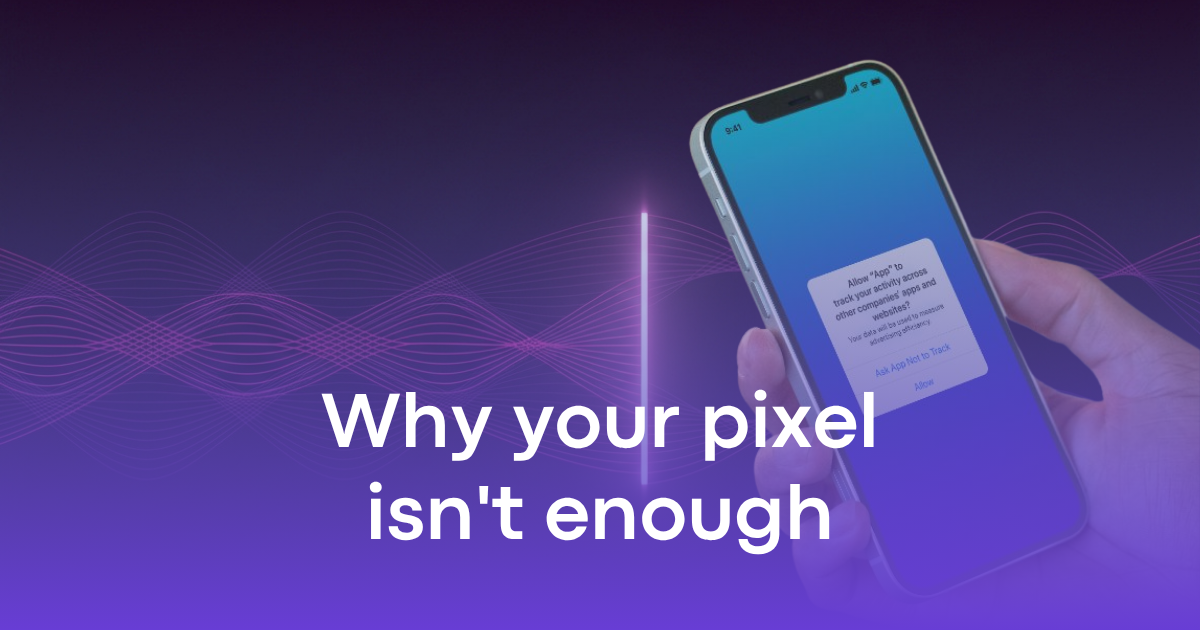
iOS 14 introduced App Tracking Transparency. Safari started blocking third-party cookies. Chrome moved in the same direction. Ad blockers became standard. Users started refusing consent.
None of these changes were sudden. They happened over years. And every one of them hit the browser pixel.
Today, a pixel running on your site without server-side backup is missing somewhere between 30 and 40% of real conversions. Not because your campaigns are broken. Not because your creative is wrong. Because the infrastructure collecting purchase data was built for a different era.
The AI optimizing your campaigns does not know what it is missing. It keeps spending. It keeps learning. It learns from an incomplete picture.
What a Conversion API actually does
A Conversion API, or CAPI, moves the data collection from the browser to your server.
Instead of relying on a JavaScript tag firing inside someone's browser, your server captures the event directly and sends it to the ad platform through an official API connection. The browser environment, with all its restrictions and blockers, is no longer in the path.
Meta has the Conversions API. TikTok has the Events API. Snap, Google, and Amazon each have equivalent server-side connections. These are official integrations, built and maintained by the platforms themselves.
The mechanism is straightforward:
A user completes a purchase. Your backend records it. That event, with hashed identifiers including email address and phone number, is sent directly to the ad platform. In real time. Regardless of what browser the user is running, what consent settings they have, or what ad blocker is installed.
The purchase reaches the platform. The AI learns from it. The model improves.
Why sending events is not the same as fixing the problem
Most implementations stop at transmission. The event fires, the data moves, the checkbox is ticked.
That is not enough.
Sending an event and sending a usable event are not the same thing.
Ad platforms match your events to real people in their systems using identifiers: email addresses, phone numbers, device IDs. The quality of that match determines how much the AI can learn from each conversion. A high match rate means the platform can connect your event to an actual user profile. A low match rate means the event lands but the platform cannot use it well.
Most brands do not know their match rate. Most brands have never been told to check it.
There is also the problem of duplication. If you run a pixel alongside a CAPI without proper deduplication logic, you can send the same event twice. The platform counts two purchases instead of one. The AI trains on inflated data. Performance appears strong. Efficiency degrades silently.
And there is taxonomy alignment. Different platforms expect different event formats. What Meta needs to see in a purchase event is not identical to what TikTok expects. Sending events without formatting them correctly for each destination creates partial or invalid signals.
Transmission is the first step. It is not the job.
What changes when signals are complete
When a Conversion API is implemented correctly, with proper identifier hashing, deduplication, and platform-native formatting, the data feeding your ad platform AI becomes complete.
The AI stops optimizing from an incomplete picture.
Audiences improve because the model is training on real buyers, not just the ones the browser managed to capture. Budget allocation improves because the AI is seeing which campaigns are actually producing customers. ROAS stabilizes because the signal is no longer dropping in and out based on browser behavior.
Jarir Bookstore saw a 205% increase in purchases visible to Meta after implementing server-side conversion delivery. ROAS increased 182%. Same campaigns. Same budgets. Same ads.
The only thing that changed was what the algorithm could see.
The infrastructure question most teams are not asking
Performance marketers spend significant time on campaign structure, creative, audience targeting, and bid strategies.
Very few spend time asking whether the signals feeding their ad platforms are complete and correct.
That is the question that determines everything else. If the input is broken, the output will be wrong. If the AI is learning from incomplete data, every decision it makes downstream is based on a partial view of reality.
A Conversion API is not a technical upgrade. It is the infrastructure that makes AI-driven advertising work the way it was designed to.
The question is not whether to implement one.
The question is whether yours is actually working.