How Ad Signal Infrastructure Improves Meta, TikTok, Snap, and Google ROAS

Ad signal infrastructure is the system that captures, validates, and delivers conversion data from your business to ad platforms in real time. It ensures that every purchase, sign-up, or completed action reaches Meta, TikTok, Snap, Google, and Amazon so their algorithms can optimize your campaigns accurately.
Without complete conversion signals, ad platform AI operates on incomplete data. The result is wasted budget, rising CPAs, and unpredictable ROAS.
What is ad signal infrastructure
Ad signal infrastructure sits between your business data sources and your ad platforms. It collects conversion events from your website, mobile app, CRM, and offline systems, then delivers them server-side to each platform's Conversion API in real time.
It operates across five functions:
- Capture: Server-side collection of conversion events from web, mobile, CRM, offline, and payment systems before the browser loses them
- Validate: Quality checks on every signal before delivery (deduplication, taxonomy alignment, identifier quality, anomaly detection)
- Enrich: Hashed identifiers added to every event to maximize match rates across all connected platforms
- Activate: Simultaneous real-time delivery to ad platforms like Meta, TikTok, Snap, Google, and Amazon via official Conversion APIs, in platform-native format
- Learn: Continuous monitoring of signal quality based on match rate performance, anomaly detection, and platform feedback
Why ad platforms lost visibility into conversions
The traditional tracking model relied on client-side pixels running in the user's browser. Privacy changes made that model unreliable.
Browser and OS restrictions on client-side tracking
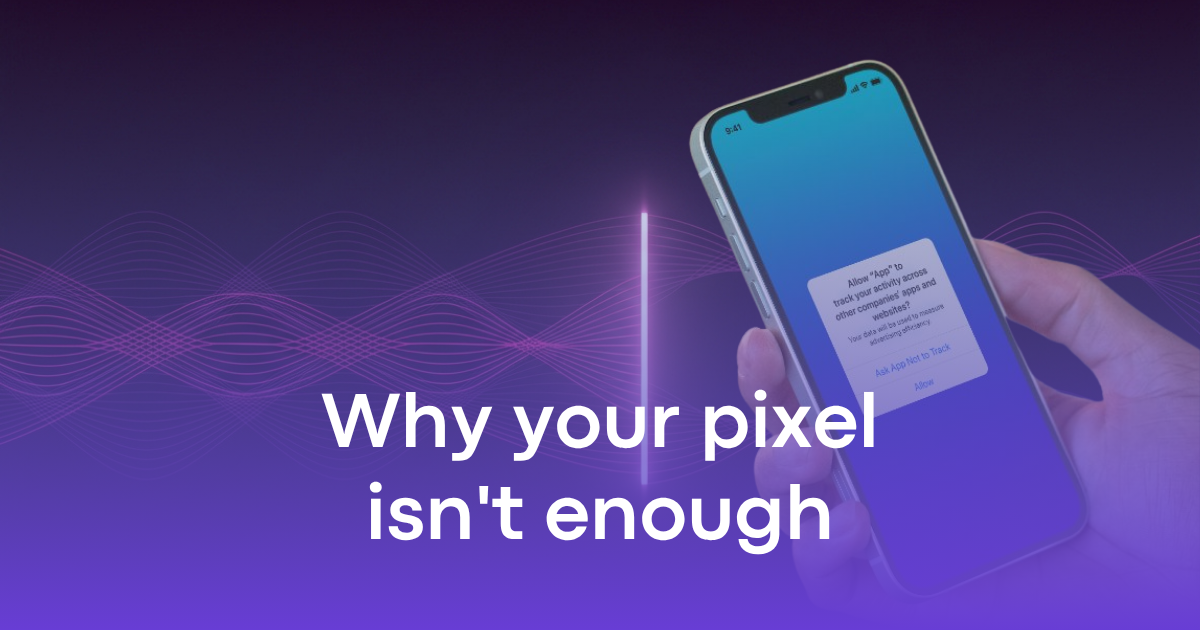
Safari's Intelligent Tracking Prevention limits cookie lifespans. Firefox's Enhanced Tracking Protection blocks third-party trackers. iOS App Tracking Transparency requires explicit opt-in before cross-app tracking can occur. These restrictions prevent pixels from capturing complete conversion data.
Consent requirements that block signal flow
GDPR, CCPA, and regional privacy regulations require user consent before tracking. When users decline consent banners, pixels cannot fire. Conversions happen but are never reported to the platform.
The conversion gap no one warned you about
Brands typically discover signal loss only after ROAS declines. No error messages appear. Dashboards continue reporting conversions. The gap only becomes visible when platform-reported conversions are compared to actual backend records. Browser pixels now miss 20 to 40% of real purchases.
How incomplete signals break algorithm learning
Meta Advantage+, Google Performance Max, and TikTok Smart Campaigns rely on conversion signals to optimize bidding and targeting. Incomplete signals produce inaccurate models.
| Signal state | Algorithm behavior | Business impact |
|---|---|---|
| Complete, real-time signals | Optimizes toward actual buyers | Efficient spend, predictable ROAS |
| Incomplete or delayed signals | Optimizes toward incomplete patterns | Wasted budget, rising CPA |
| Missing high-value conversions | Undervalues best customers | Scales wrong audiences |
"When platforms receive partial conversion data, they allocate budget toward the customers they can see, not all customers. High-value conversions that never arrived are invisible to the algorithm. Feed the algorithm incomplete data and it will optimize confidently in the wrong direction."
The five layers of ad signal infrastructure
Journify's ad signal infrastructure covers all five layers of the conversion signal path.
Capture
Server-side event capture collects conversions from web, mobile app, CRM, offline, and payment systems. Because capture runs on your server, ad blockers and browser restrictions cannot prevent events from being recorded.
Validate
Every signal is checked before delivery. Duplicate events, missing required fields, taxonomy misalignment, and identifier issues are caught before they reach the platform. A transmitted event the platform cannot use is not a delivered event.
Enrich
Every event is enriched with hashed identifiers to maximize match rates by platform. Ad platforms can only learn from events they can connect to a real person.
Activate
Validated, enriched signals are sent via official Conversion APIs to Meta, TikTok, Snap, Google, and Amazon simultaneously, in platform-native format, in real time. Bidding decisions occur in milliseconds. Delayed signals cannot influence live auctions.
Learn
Signal quality is monitored continuously based on match rate performance, anomaly detection, and platform feedback. Signal quality degrades silently without active management. Learn closes the loop so the data ad platforms receive gets better, not just bigger.
Server-side signal flow vs client-side pixels
| Factor | Client-side pixel | Server-side signal flow |
|---|---|---|
| Where it runs | User's browser | Your server |
| Affected by ad blockers | Yes | No |
| Affected by iOS restrictions | Yes | No |
| Data completeness | Partial | Complete |
| Real-time delivery | Depends on page load | Yes |
| Requires dev resources | No | Yes, unless using infrastructure like Journify |
Server-side signal flow sends conversion data directly from your server to the ad platform. It bypasses browser restrictions, consent limitations, and device-level privacy settings entirely.
What ad signal infrastructure is not
Ad signal infrastructure is a distinct category. It is not a CDP, which stores and segments customer data. It is not an attribution tool, which reports where conversions came from. It is not a dashboard, which visualizes data that may already be incomplete. Signal infrastructure ensures the conversion data underlying all of those tools is complete in the first place.
Match rates and ROAS from complete signal flow
When ad signal infrastructure is implemented correctly, match rates improve and ROAS increases without changes to campaigns, creative, or budget.
Jarir Bookstore saw +205% attributed purchases and +182% ROAS on Meta after implementing complete signal flow through Journify. Baytonia delivered +80% ROAS and -44% cost per purchase on TikTok. Lumi achieved +170% app installs and -50% cost per install on Snap.
Google Enhanced Conversions improve Performance Max campaign accuracy by matching more conversion events to users through hashed first-party data. Complete signals produce better bidding decisions across Search, Shopping, and Display.
How to evaluate signal infrastructure for your brand
When assessing your current setup or evaluating a vendor, these criteria determine whether signal infrastructure will deliver complete conversion data.
- Coverage: Captures from web, app, CRM, and offline sources
- Platform support: Connects to Meta, TikTok, Snap, Google, and Amazon
- Match rate visibility: Shows current match rates by platform
- Data validation: Catches bad data before delivery
- Implementation speed: Deploys without engineering tickets
- Regional fit: Integrates with local platforms such as Salla and Tabby for GCC brands
The infrastructure layer that feeds ad platform AI
Ad performance depends on signal quality. Ad platforms allocate budgets, optimize bidding, and find new customers based on the conversion data they receive. Brands with complete signal infrastructure give their algorithms accurate inputs. Brands without it are funding optimization based on partial truth.
Journify offers a free signal audit → Book one here
FAQs about ad signal infrastructure
Does ad signal infrastructure require engineering resources to implement?
Journify deploys without engineering tickets. Pre-built Conversion API integrations connect your data sources and ad platforms directly. Custom implementations involving offline systems or proprietary apps may require some technical input, but most brands are live within days, not sprints.
How long does it take to see ROAS improvements after implementing ad signal infrastructure?
Brands typically see algorithm learning improve within the first few weeks as platforms receive more complete conversion data. Full optimization depends on campaign volume and learning phase duration.
Is ad signal infrastructure the same as server-side tracking?
No. Server-side tracking is one component. Full infrastructure includes data validation, event formatting for each platform, multi-platform delivery, and signal health monitoring.
Which ad platforms support Conversion API and server-side event delivery?
Meta, TikTok, Snap, Google, and Amazon all support Conversion API or server-side event integrations. Each platform has different technical specifications and requirements.
How do I know if my ad platform AI is optimizing on incomplete data?
Ad platforms do not flag missing conversions. Dashboards report what they received, not what actually happened. The clearest indicator is ROAS becoming harder to explain, CPAs drifting without a clear cause, or campaigns underperforming with no obvious reason. These are often signal problems, not media problems.