First-party data: what it is and why it matters for ad performance

Every ad platform you use runs on data. The question is whose data, and how clean it is.
First-party data is the information your business collects directly from its own customers and website visitors. It comes from your systems: purchase records, checkout events, CRM entries, app activity, and any interaction a customer has directly with your brand. You own it. You control it. No third party sits between you and the source.
That distinction matters more than it used to.
Why first-party data became critical for ad performance
For years, performance marketers relied on browser-based tracking to feed ad platforms with conversion signals. A pixel fired when someone purchased, Meta recorded the event, and the algorithm learned who to target next.
That pipeline broke.
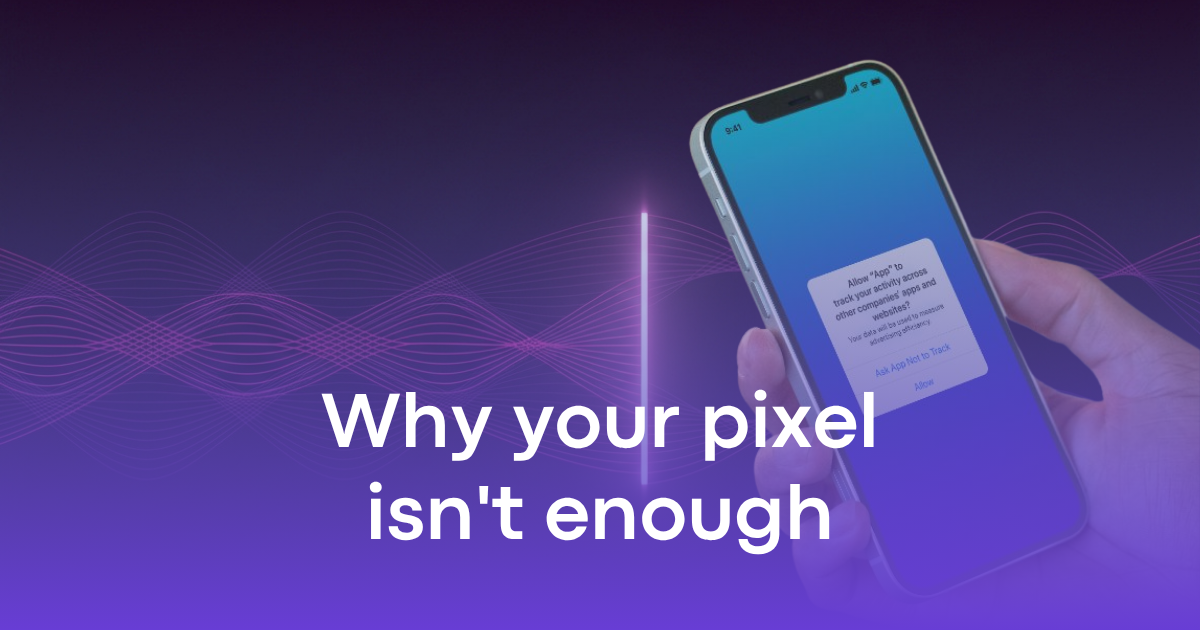
iOS App Tracking Transparency, browser restrictions, and cookie deprecation fragmented the signal. Browser pixels now miss 30 to 40% of purchases. The ad platform AI does not know what it is missing. It keeps optimizing from an incomplete picture, which means budgets drift toward the wrong campaigns and ROAS becomes harder to explain.
First-party data is what fills that gap. Because it lives in your backend systems, it is not subject to browser limitations. A completed checkout recorded in your CRM happened, regardless of what the pixel captured.
First-party data vs third-party data
The difference is ownership and origin.
First-party data comes directly from your customers through their interactions with your business. It is accurate, current, and yours to use. Third-party data is purchased or licensed from external providers who aggregated it from sources you have no direct relationship with. It is broader in reach but lower in accuracy, and increasingly restricted by privacy regulations and platform policy.
For ad performance specifically, first-party data is significantly more valuable. It reflects real behavior from real customers in your actual funnel. Third-party data tells you something about a population. First-party data tells you something about the people who already buy from you.
That is the input ad platform AI needs to find more of them.
What counts as first-party data for advertising
The scope is broader than most performance teams realize.
Purchase and transaction records
Every completed order your backend or payment system records is first-party data. This is the most valuable signal you can send to an ad platform because it represents a real conversion, not a proxy for one.
Server-side checkout and cart events
Add-to-cart, initiate checkout, and purchase events captured server-side before the browser loses them. These are the events most commonly missed by pixel-only setups.
CRM data
Customer emails, phone numbers, lifecycle stage, and purchase frequency. When this data is hashed and sent to ad platforms, it raises match rates and improves the quality of every signal you deliver.
App behavior
Installs, in-app purchases, and engagement events from mobile users. Especially relevant for brands running campaigns on Snap and TikTok where app activity drives a significant share of conversions.
Offline conversions
In-store sales, call center records, and manual entries tied to a customer profile. This data almost never reaches ad platforms by default, which means the campaigns that drove those customers get no credit for them.
How first-party data connects to ad platform AI
Ad platforms like Meta, TikTok, Snap, and Google do not distribute budgets based on audience parameters. They run on AI optimization engines that learn from conversion signals and find more buyers who behave like existing customers.
The quality of that learning depends entirely on the quality of the signals they receive.
When your first-party data reaches ad platforms completely and correctly, the AI optimizes on a full picture of your customers. Targeting improves. Budget allocation stabilizes. The algorithm finds buyers who actually convert, not approximations of them based on incomplete data.
When it does not, the platform works from whatever the browser managed to capture. Which is, on average, 60 to 70% of what actually happened.
The gap between having first-party data and using it
Most brands already have first-party data. The problem is that it never reaches ad platforms completely, or it arrives in a form the platform cannot use.
Events sent without proper identifiers get low match rates. Duplicate events confuse the algorithm. Offline data stays in the CRM and never connects to a paid campaign. The signal exists but it does not land.
This is not a data collection problem. It is a signal delivery problem.
Sending events server-side is a start. But transmission alone does not guarantee quality. Events need to be validated before delivery, enriched with the right identifiers to maximize match rates, and deduplicated so the platform is not learning from the same conversion twice.
First-party data and match rates
Match rate is the metric that tells you how much of your first-party data is actually usable by the platform. See how match rate differs across platforms and what drives those differences.
When you send a conversion event, the platform tries to match it to a real user in its system using identifiers like email address, phone number, or device ID. If those identifiers are missing, incorrectly formatted, or not hashed properly, the event cannot be matched. It counts as received but contributes nothing to optimization.
On Meta, a strong match rate sits above 7.0. If yours is below that, your first-party data is reaching the platform but not doing the work it should.
Improving match rate does not require more data. It requires sending the data you already have in the right format, with the right identifiers, every time.
How to know if your first-party data is reaching ad platforms
The fastest way to find out is to compare what your backend records against what the ad platform reports.
If Meta shows 800 purchases in a week and your backend shows 1,200, that gap is signal loss. Some of it may be attribution methodology. Most of it is first-party data that never arrived, arrived without identifiers, or arrived in a format the platform could not process.
Other indicators: match rates below platform benchmarks, ROAS volatility that does not correlate with creative or budget changes, and lookalike audiences that underperform despite clean creative and healthy spend.
None of these are campaign problems. They are data problems.
Run a free signal audit
If you are not sure how much of your first-party data is actually reaching ad platforms, a signal audit gives you a concrete answer. It shows the gap between what your business records and what Meta, TikTok, Snap, and Google actually receive, and where in the pipeline the loss is happening.
Run a free signal audit